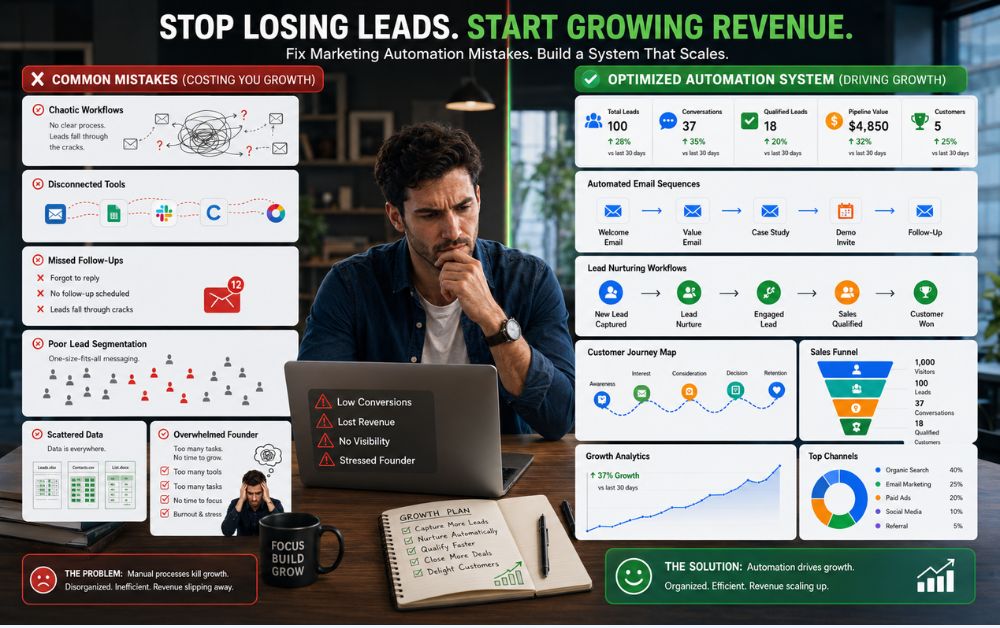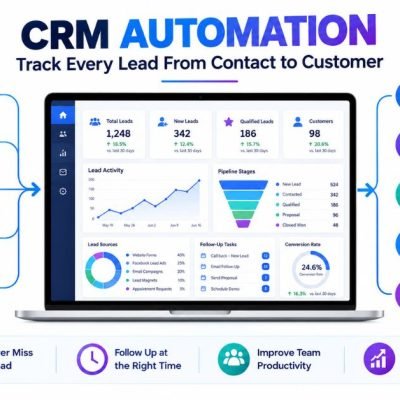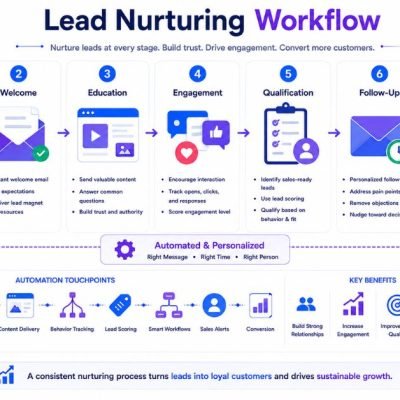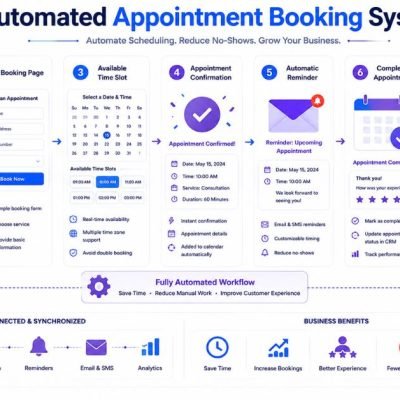

Marketing automation for startups is often misunderstood as something only large companies need. In reality, startups usually benefit from automation even more because they operate with smaller teams, tighter budgets, and limited time.
Most founders begin by managing everything manually. They answer inquiries, track leads, send follow-up emails, schedule calls, and monitor marketing campaigns themselves. While this approach may work in the early stages, it becomes increasingly difficult as the business grows.
The first few customers are usually easy to manage. The next fifty become challenging. The first hundred leads often expose weaknesses in a startup’s processes.
Emails get missed.
Follow-ups are delayed.
Potential customers lose interest.
Important opportunities slip away unnoticed.
The problem isn’t a lack of effort. Most startup founders work incredibly hard. The real issue is that manual systems cannot scale at the same pace as business growth.
This is where marketing automation creates a competitive advantage.
By automating repetitive tasks such as lead nurturing, customer onboarding, email marketing, appointment reminders, and follow-up sequences, startups can build systems that continue working even when teams are busy. Instead of spending hours on administrative work, founders can focus on product development, customer relationships, and strategic growth.
More importantly, automation helps create consistency. Every lead receives timely communication, every customer enters a structured journey, and every interaction becomes easier to track and optimize.
The startups that scale successfully are rarely the ones doing everything manually. They are the ones building repeatable systems that allow growth without dramatically increasing workload.
In this guide, we’ll explore nine practical ways startups can use marketing automation to overcome growth bottlenecks, improve lead generation, strengthen customer relationships, and build a more scalable business
Most startup founders expect challenges such as funding, competition, and customer acquisition. However, some of the biggest obstacles to growth are far less visible. These hidden bottlenecks often develop quietly in the background and become serious problems before founders even realize they exist.
One common bottleneck is inconsistent lead management. A startup may successfully generate interest through content, advertising, or referrals, but without a structured system, valuable prospects can easily be forgotten. Missed follow-ups and delayed responses often result in lost opportunities, regardless of how good the product or service may be.
Another overlooked challenge is communication overload. As inquiries increase, founders frequently spend more time answering emails, managing contacts, and scheduling calls than focusing on business growth. What initially feels manageable can quickly become a daily distraction that limits productivity.
Data fragmentation creates another growth barrier. Customer information often becomes scattered across spreadsheets, email inboxes, messaging platforms, and multiple software tools. Without centralized visibility, it’s difficult to understand where leads come from, which campaigns perform best, or what actions drive conversions.
This is why many growing businesses eventually invest in systems that automate routine processes. Resources like marketing automation software for small businesses explain how modern automation platforms help organize customer journeys, improve follow-up consistency, and reduce operational complexity.
For startups requiring advanced CRM functionality and lead management, GoHighLevel provides tools designed to centralize customer communication and automate repetitive tasks. Businesses looking for a simpler, budget-friendly approach often explore Systeme.io as an all-in-one platform for funnels, email marketing, and automation.
The startups that scale successfully are often not the ones working harder. They are the ones identifying these hidden bottlenecks early and building systems that prevent them from slowing future growth.
Why Manual Processes Kill Startup Momentum
In the early stages of a startup, manual processes often seem like a practical solution. Founders personally respond to inquiries, track leads in spreadsheets, send follow-up emails, and manage customer communication themselves. This hands-on approach works when customer volume is low, but it becomes increasingly inefficient as the business grows.
The biggest problem with manual processes is that they don’t scale. Every new lead, customer inquiry, or sales opportunity requires additional time and attention. Eventually, founders reach a point where there simply aren’t enough hours in the day to handle everything effectively.
This creates what many startups experience as a growth plateau. Marketing efforts generate interest, but lead response times slow down. Customer follow-ups become inconsistent. Important conversations get lost in crowded inboxes. Prospects who were once interested move on because they didn’t receive timely communication.
Manual systems also make it difficult to maintain consistency. Different team members may follow different processes, resulting in uneven customer experiences. Without standardized workflows, businesses often struggle to deliver the same level of service as they grow.
Another challenge is the lack of visibility. When information is stored across spreadsheets, email accounts, and separate tools, it becomes difficult to understand what is working and what isn’t. Founders may spend significant amounts of time gathering data instead of making strategic decisions.
This is one reason why many startups eventually transition toward automation-based systems. Businesses researching solutions can explore marketing automation software for small businesses to understand how automation helps streamline communication, lead management, and customer engagement.
Platforms such as GoHighLevel and Systeme.io allow startups to automate repetitive activities, reduce administrative workload, and create more consistent customer experiences.
Successful startups rarely scale through harder work alone. They scale by replacing manual bottlenecks with systems that allow growth to happen efficiently and predictably.
The First 100 Leads Problem
For many startups, generating the first few leads feels like a major achievement. Friends, referrals, social media contacts, and early marketing efforts often bring in the initial wave of interest. At this stage, managing leads manually seems simple because the volume is still low.
The real challenge begins when a startup reaches its first 100 leads.
Suddenly, keeping track of every conversation becomes much harder. Some prospects request more information, others schedule calls, and many require multiple follow-ups before making a decision. Without a structured process, it becomes easy to forget who needs a response and when.
This is where many startups unknowingly lose potential customers.
Research consistently shows that lead response time has a significant impact on conversion rates. A prospect who receives a timely response is generally more likely to remain engaged than one who waits several days for a reply. As lead volume grows, delayed communication becomes one of the most common reasons startups struggle to convert interest into revenue.
Another issue is lead prioritization. Not every lead is equally valuable. Some prospects are actively looking for a solution, while others are simply gathering information. Without a system for organizing and tracking these interactions, startups often spend too much time on low-priority leads while high-intent prospects slip away.
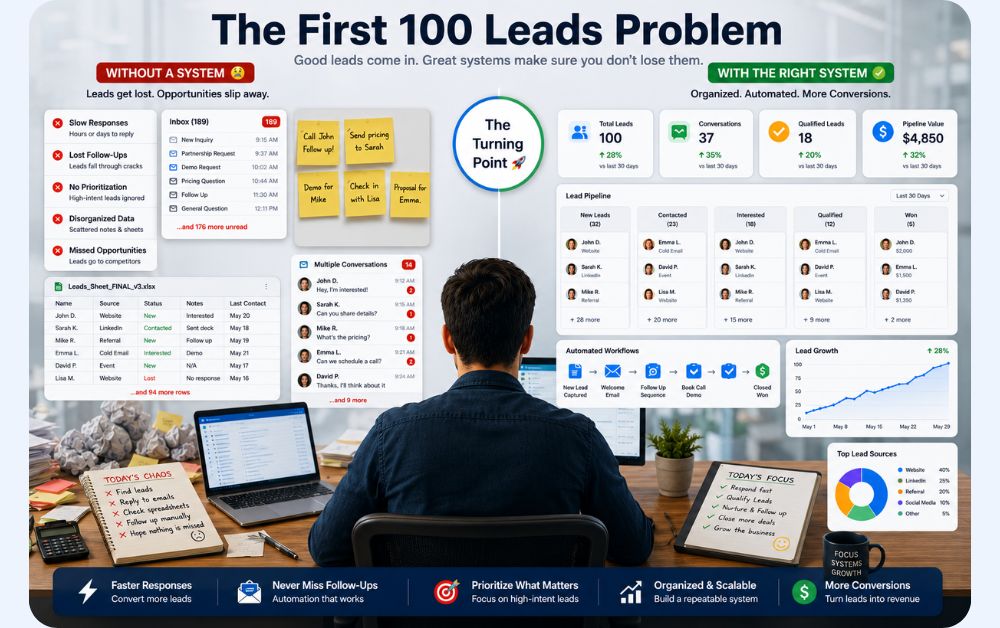
As lead volume increases, startups need repeatable systems rather than memory-based processes. Lead tracking, automated follow-ups, and organized customer journeys help ensure every prospect receives the right attention at the right time.
Businesses exploring ways to improve lead management can learn more from our guide on marketing automation software for small businesses, which explains how automation tools help organize growing customer pipelines.
The first 100 leads often reveal whether a startup has a scalable growth system or simply a collection of manual tasks. Founders who solve this problem early are usually in a much stronger position when lead volume continues to grow.
Building a Scalable Customer Acquisition System
One of the biggest differences between startups that struggle and those that grow consistently is the presence of a scalable customer acquisition system. While many founders focus heavily on generating more traffic, long-term growth usually depends on having a reliable process for turning visitors into leads and leads into customers.
A customer acquisition system is more than a marketing campaign. It is a structured process that guides potential customers through every stage of the buying journey. Instead of relying on random referrals or occasional sales spikes, startups create predictable pathways that consistently attract and convert prospects.
The foundation of a scalable system begins with lead capture. Whether visitors arrive through search engines, social media, content marketing, or referrals, there should be a clear method for collecting contact information and starting a relationship. Without lead capture, valuable traffic often leaves without taking any meaningful action.
The next stage is lead nurturing. Most prospects are not ready to make an immediate purchase. They need time to understand the problem, evaluate solutions, and build trust in a brand. Consistent communication helps keep the business top of mind during this decision-making process.
Startups should also focus on creating repeatable customer journeys. Every lead should move through a defined process rather than receiving random follow-ups. This makes growth more predictable and reduces the risk of missed opportunities.
Businesses looking to strengthen their acquisition process can explore our guide on marketing automation software for small businesses to understand how modern systems support lead generation, nurturing, and conversion tracking.
The goal is not simply to acquire more customers. The goal is to build a system that can handle increasing demand without creating additional complexity. When customer acquisition becomes structured and repeatable, startups are better positioned to grow efficiently, make data-driven decisions, and scale with confidence.
How Startups Can Automate Lead Follow-Up
Generating leads is only the first step in the customer acquisition process. The real challenge begins after a prospect expresses interest. Many startups invest significant effort into attracting visitors but lose potential customers because follow-up communication is inconsistent or delayed.
Lead follow-up is important because most prospects are not ready to make a purchase immediately. They often need additional information, time to compare options, and reassurance before making a decision. Without a structured follow-up process, interested leads can quickly forget about a business or choose a competitor that stays in touch more effectively.
Automation helps solve this problem by ensuring every lead receives timely and relevant communication. Instead of manually tracking conversations and sending individual emails, startups can create automated sequences that guide prospects through the buying journey.
For example, when a visitor downloads a guide, submits a contact form, or requests information, an automated workflow can immediately send a welcome message. Over the following days, additional emails can provide educational content, answer common questions, and introduce relevant solutions. This keeps the business visible while building trust with potential customers.
Automation also improves consistency. Every lead enters the same structured process, reducing the risk of missed opportunities. Team members no longer need to rely on memory, spreadsheets, or scattered notes to manage follow-ups.
Another advantage is better lead tracking. Startups can see which emails are opened, which links are clicked, and which prospects are actively engaging with content. These insights help businesses identify high-intent leads and prioritize conversations more effectively.
Businesses looking to strengthen their lead management process can explore our guide on marketing automation software for small businesses to understand how automation platforms support lead nurturing and customer engagement.
The goal of lead follow-up automation is not to replace human interaction. It is to ensure that no opportunity is forgotten while allowing startup teams to focus their time on meaningful conversations that drive growth.
Choosing Your First Automation Stack
Choosing your first automation stack can feel overwhelming. Many startup founders assume they need dozens of tools to compete effectively, but the opposite is often true. The most successful startups usually begin with a simple system that solves a few critical problems exceptionally well.
Your first automation stack should focus on three essential areas: capturing leads, nurturing prospects, and managing customer relationships. These functions directly influence revenue growth and help create a more predictable customer acquisition process.
Instead of relying on spreadsheets, manual reminders, and scattered communication channels, startups should aim to centralize their workflows. When lead information, customer interactions, and follow-up activities exist in one system, it becomes much easier to track progress and identify opportunities.
A practical automation stack often includes a CRM, email automation platform, lead capture forms, and a basic sales funnel. Together, these components help ensure that every new lead enters a structured process rather than being managed manually. Businesses looking to understand the role of automation tools in greater depth can explore our guide on marketing automation software for small businesses.
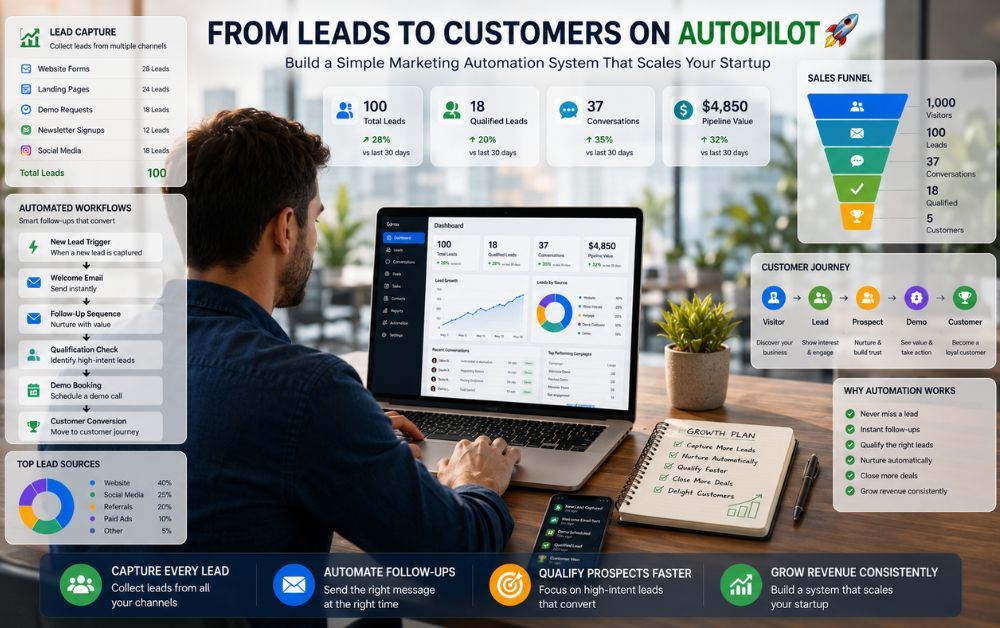
As your startup grows, the ability to automate repetitive tasks becomes increasingly valuable. Platforms such as GoHighLevel provide advanced CRM and automation capabilities for businesses that need more control over customer relationships and lead management. Founders looking for a streamlined all-in-one platform often consider Systeme.io because it combines funnels, email marketing, and automation within a single ecosystem.
The key is not choosing the most complex technology stack. The goal is to select tools that reduce manual work, improve consistency, and support sustainable growth as your startup continues to scale.
GoHighLevel for Service Startups
Service-based startups often face a unique challenge: managing a growing number of leads while continuing to deliver high-quality customer service. As inquiries increase, founders can quickly become overwhelmed by follow-ups, appointment scheduling, customer communication, and sales tracking. Without structured systems, valuable opportunities can easily slip through the cracks.
This is where GoHighLevel stands out as a solution designed for businesses that depend heavily on lead generation and client management. Rather than using multiple disconnected tools, service startups can manage customer interactions, sales pipelines, and marketing activities within a centralized system.
One of the biggest advantages for service-based businesses is improved lead visibility. Every inquiry, conversation, and follow-up can be tracked throughout the customer journey. This makes it easier to understand where prospects are in the sales process and identify which opportunities require attention.
Automation also plays an important role. Instead of manually sending follow-up emails or reminders, startups can create workflows that automatically engage prospects at different stages of the buying journey. This helps maintain consistent communication while reducing administrative workload.
Another benefit is appointment management. Many service businesses rely on consultations, discovery calls, or scheduled meetings to generate revenue. Automating scheduling and reminders helps reduce missed appointments while improving the customer experience.
For startups building their customer acquisition process, combining automation with a structured lead management system can significantly improve efficiency. Businesses interested in broader automation strategies can explore our guide on marketing automation software for small businesses to better understand how automation supports long-term growth.
GoHighLevel is particularly valuable for agencies, consultants, coaches, local service providers, and other businesses that depend on relationship-driven sales. By organizing customer data, automating repetitive tasks, and improving lead management, service startups can spend less time on manual processes and more time delivering value to clients and growing the business.
Systeme.io for Bootstrapped Founders
Bootstrapped founders often operate under different conditions than venture-funded startups. Limited budgets, small teams, and multiple responsibilities require tools that are affordable, easy to use, and capable of handling several business functions without requiring significant technical expertise.
This is one reason many entrepreneurs are attracted to Systeme.io. Instead of purchasing separate software for email marketing, sales funnels, automation, landing pages, and digital product delivery, founders can manage these activities from a single platform.
For startups with limited resources, simplicity can be a significant advantage. Rather than spending weeks learning complex systems, founders can focus on building offers, generating leads, and serving customers. This allows businesses to move faster while avoiding unnecessary operational complexity.
Another benefit is the ability to create structured customer journeys. When a visitor joins an email list, downloads a resource, or signs up for an offer, automation workflows can guide them through a consistent follow-up process. This helps startups maintain communication without manually managing every interaction.
Sales funnels also play an important role in customer acquisition. Founders who are new to funnel building can review our guide on how to build your first sales funnel to understand how funnels support lead generation and conversions.
As businesses grow, automation becomes increasingly valuable for reducing repetitive work and improving efficiency. Founders looking to explore broader automation strategies can also read our guide on marketing automation software for small businesses.
Systeme.io is particularly well suited for solo founders, creators, coaches, consultants, and small online businesses that want a straightforward platform for managing marketing and sales activities. For bootstrapped startups focused on growth while keeping costs under control, it offers a practical starting point for building scalable systems and improving operational efficiency.
Startup Automation Mistakes to Avoid
Marketing automation can help startups save time, improve customer communication, and scale more efficiently. However, many founders make the mistake of assuming that simply purchasing software will automatically solve growth challenges. In reality, automation works best when it supports a clear business process.
One of the most common mistakes is automating too much too early. Startups often create complex workflows before understanding their customer journey. When processes are unclear, automation simply accelerates inefficiency rather than improving results.
Another mistake is focusing on tools instead of strategy. Many founders spend weeks comparing software features but never define how leads will move through the sales process. Successful automation starts with understanding customer needs, not software capabilities.
Poor lead segmentation is another issue. Treating every lead the same can reduce engagement and lower conversion rates. Prospects at different stages of the buying journey require different types of communication. Effective automation delivers relevant messages based on customer behavior and intent.
Some startups also neglect follow-up optimization. Automated emails and workflows should be reviewed regularly to ensure they remain relevant and effective. Customer expectations change over time, and automation systems should evolve alongside the business.
For founders building their first automation systems, understanding the fundamentals is often more valuable than adopting advanced features. Businesses exploring automation strategies can learn more from our guide on marketing automation software for small businesses. Founders interested in funnel-based lead generation can also review how to build your first sales funnel.
Platforms such as GoHighLevel and Systeme.io provide powerful automation capabilities, but long-term success depends on how effectively those tools are implemented.
The goal of automation is not to remove the human element from business. The goal is to eliminate repetitive tasks so founders can spend more time building relationships, solving customer problems, and driving sustainable growth.