When most people start an online business, they focus on one thing:
That sounds logical at first.
More visitors should mean more sales… right?
Not exactly.
A lot of beginners actually get visitors.
The real problem is what happens after those visitors arrive.
Most people:
- don’t capture emails,
- don’t guide visitors properly,
- and don’t build any real follow-up system.
So traffic comes in…
and quietly disappears.
I used to think funnels were only for advanced marketers or big companies.
But after spending time around online business communities, reading case studies, and testing things personally, I realized something important:
! Funnels are not complicated “marketing tricks.”
They’re simply structured paths that help visitors understand:
- where they are,
- what to do next,
- and why they should stay connected.
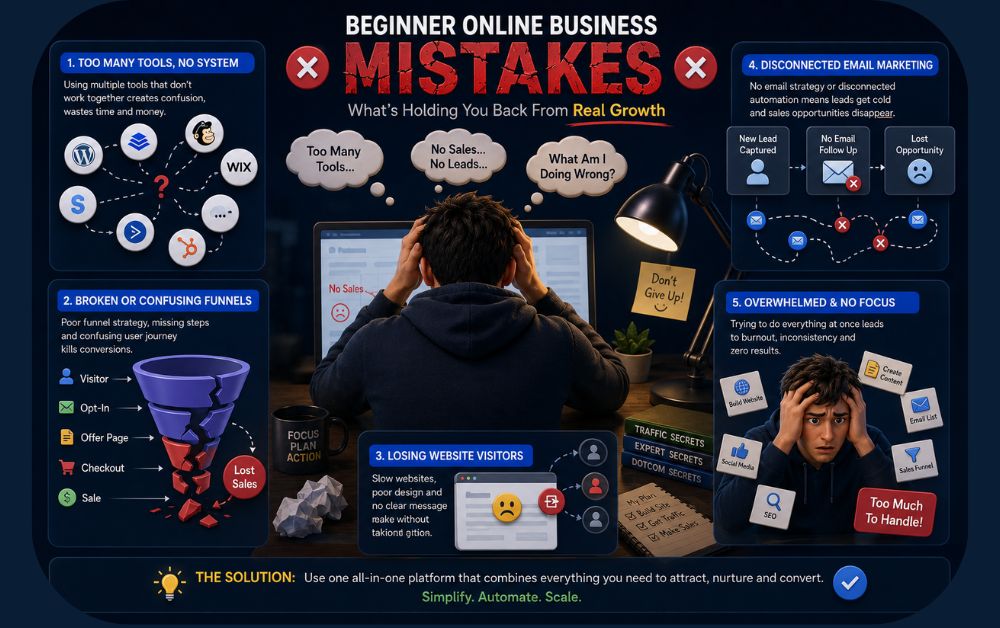
And honestly, many beginner mistakes happen before the first funnel is even built.
This happens constantly.
A beginner starts with:
- a website,
- a YouTube channel,
- social media pages,
- email marketing,
- funnels,
- automation,
- and paid ads…
all at the same time.
A few weeks later?
Everything feels messy.
The biggest problem isn’t lack of motivation.
It’s lack of focus.
Most successful online businesses start with something simple:
- one audience,
- one offer,
- one funnel,
- one traffic source.
That’s enough.
Trying to build an “empire” immediately usually creates confusion instead of progress.
2 — Sending Visitors Directly to an Offer
This is one of the most common beginner mistakes.
Someone clicks your link…
and immediately lands on a sales page asking them to buy.
But think about it from a visitor’s perspective.
They don’t know:
- who you are,
- why they should trust you,
- or whether your solution actually helps them.
That’s why direct linking often performs badly.
Funnels work better because they warm people up gradually.
For example:
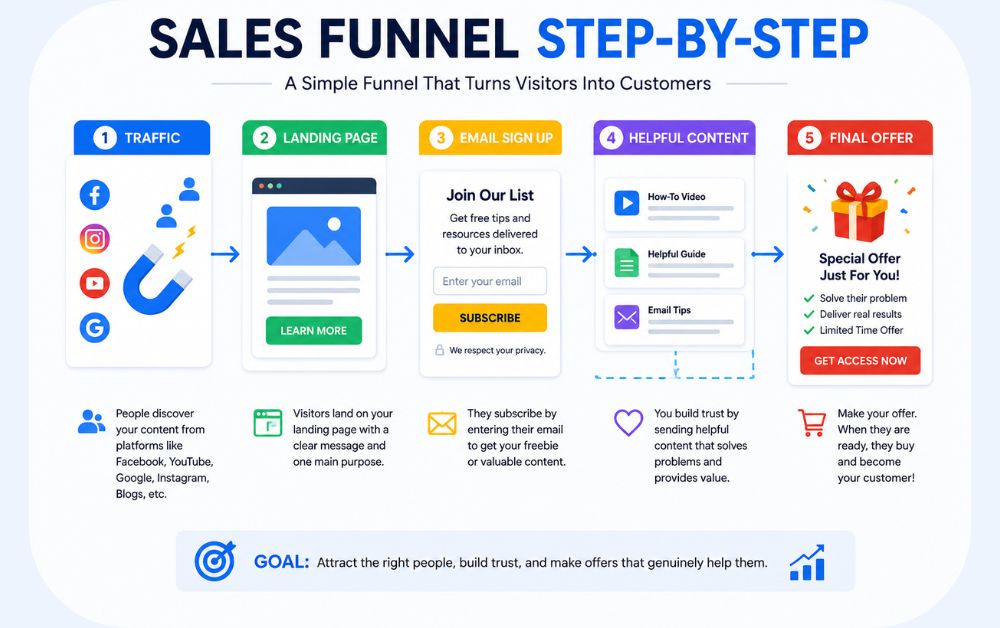
Traffic → Helpful Page → Email Signup → Useful Content → Offer
That feels much more natural.
3 — Ignoring Email Collection Completely
A surprising number of beginners build websites without collecting emails.
That means every visitor who leaves is probably gone forever.
Imagine getting:
- 100 visitors,
- then 1,000 visitors,
- then 10,000 visitors…
without building an audience you can reconnect with later.
That’s a huge missed opportunity.
Even a simple email form can make a massive difference long-term.
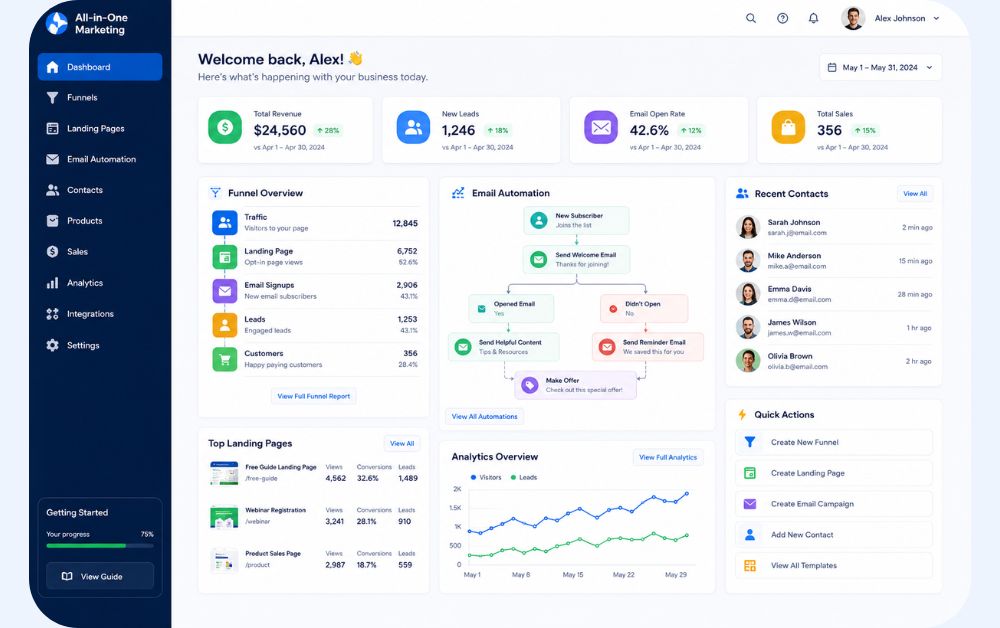
This is one reason many beginners eventually move toward funnel platforms like Systeme.io.
Instead of trying to connect multiple complicated tools together, the funnel pages and email systems already work inside the same dashboard.
For beginners, that simplicity removes a lot of friction.
4 — Overcomplicating the Funnel
A beginner sees advanced marketers using:
- upsells,
- downsells,
- webinars,
- countdown timers,
- advanced automation,
- complicated sequences…
and assumes they need all of that too.
Usually they don’t.
A simple funnel often works better than a complicated one.
Especially in the beginning.
Honestly, clarity converts better than complexity most of the time.
Visitors should instantly understand:
- what the page is about,
- what they should do next,
- and what value they’ll get.
That’s it.
5 — Choosing Tools That Feel Too Technical
This problem is bigger than people realize.
Some platforms are powerful…
but they feel overwhelming for beginners.
Too many menus.
Too many settings.
Too many integrations.
After a while, people stop building funnels and spend all their energy just learning software.
That’s why simpler all-in-one tools have become more popular recently.
With platforms like Systeme.io, beginners can:
- create pages,
- build funnels,
- send emails,
- and automate workflows
without constantly switching between different dashboards.
The easier a system feels, the easier it is to stay consistent.
And consistency matters more than perfection.
6 — Expecting Instant Results
This mistake quietly destroys motivation.
Someone launches:
- one funnel,
- writes two blog posts,
- posts a few times online…
and expects immediate income.
When that doesn’t happen quickly, frustration starts building.
But funnels usually improve through:
- testing,
- adjustments,
- audience understanding,
- and small improvements over time.
Most successful creators didn’t build high-converting systems overnight.
They improved gradually.
That’s a much healthier mindset.
7 — Building Without Understanding the Visitor Journey
This is probably the most important mistake on the list.
Many beginners focus only on:
- design,
- colors,
- logos,
- animations,
- fancy layouts.
But visitors care about something simpler:
“What problem does this solve for me?”
A good funnel answers that clearly.
Every page should guide visitors naturally toward the next step.
Not through pressure…
but through clarity.
That’s where well-structured funnels make such a big difference.
Final Thoughts
Funnels are not magic.
They won’t instantly create a successful business.
But they do solve an important problem:
! They give structure to your traffic.
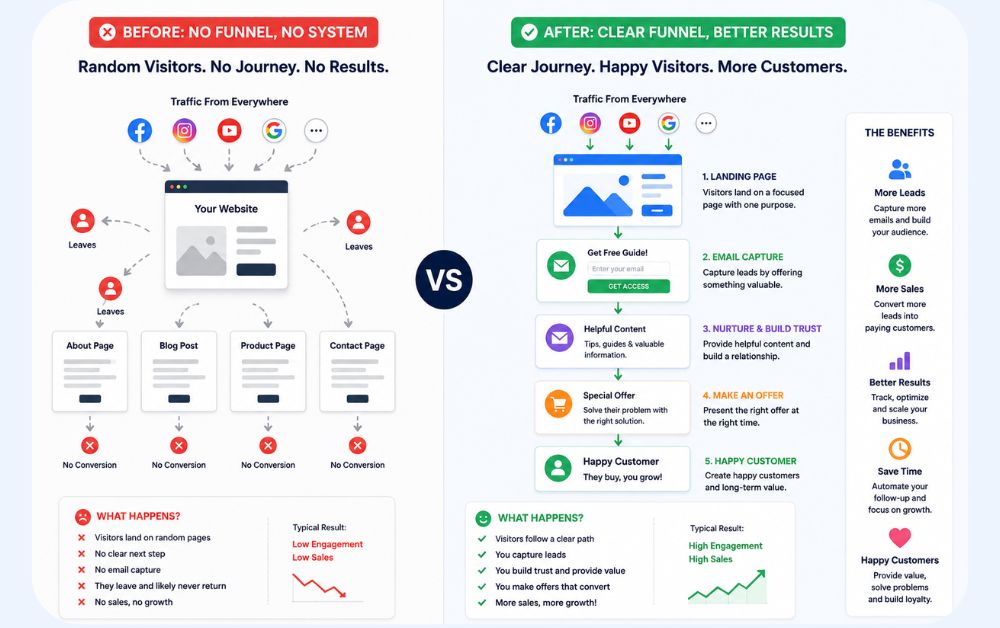
Without structure:
- visitors leave,
- opportunities disappear,
- and growth feels random.
With structure:
- visitors understand the process,
- trust builds naturally,
- and conversions become much more consistent over time.
That’s why so many beginners eventually stop chasing random tactics…
and start focusing on building simple systems that actually guide people properly.

At the end of the day…
the goal isn’t just getting visitors.
The goal is building a path that helps visitors know what to do next.